Protect Haleakalā Coalition | November 18, 2026
On Thursday, November 19, the University of Hawaiʻi Board of Regents will vote on amendments to UH’s Maunakea Master Plan, E O I Nā Leo (Listen to the Voices).
UH wants to allow new construction on retired telescope sites, and the new uses are not limited to astronomy.
Maui residents are covering this for a reason. UH manages mountaintop conservation land on two islands under the same kind of leases. What UH decides about retired telescope sites on Maunakea sets a pattern that could be repeated on Haleakalā. We do not want that to happen.
Why Maui Should Care
On October 22, the Regents voted 11-0 to approve the Kīhei MHPCC lease, with our questions unanswered. In that discussion, an administrator said UH could be in “potential” violation of the MSTARS contract without a lease base. Neil Abercrombie, the Regent who chairs the committee that reviewed this amendment, moved that approval.
Both votes took place in Honolulu. Both relied on bureaucratic terms that made the effect hard to see. We don’t know what “non-astronomy uses” the amended plan would allow on retired sites, and the packet doesn’t say.
The material changes themselves are loaded in deeply bureaucratic language. We need to make sure that Maui and Hawaiʻi Island are protected from this kind of administrative pattern.
Also concerning: an agenda item of huge importance to Maunakea and to Hawaiʻi residents is bundled with what appear to be routine approvals. It is Item VII.A.2 on the consent agenda, grouped with an investment-policy exception, a Farrington Highway film-studio lease and a foundation grant indemnification. Consent items are normally approved together in a single vote. The item gets no separate call-out and no time set aside for questions and answers.
UH Board of Regents meetings run in an administrative grey zone that limits public engagement to set slots. Public comment happens in a segment well before the Board discusses and decides anything.
Here Are the Changes UH Wants to Make

Our analysis follows. Protect Haleakalā is watching the Board of Regents closely, after seeing firsthand how it operated at the October 22 meeting.
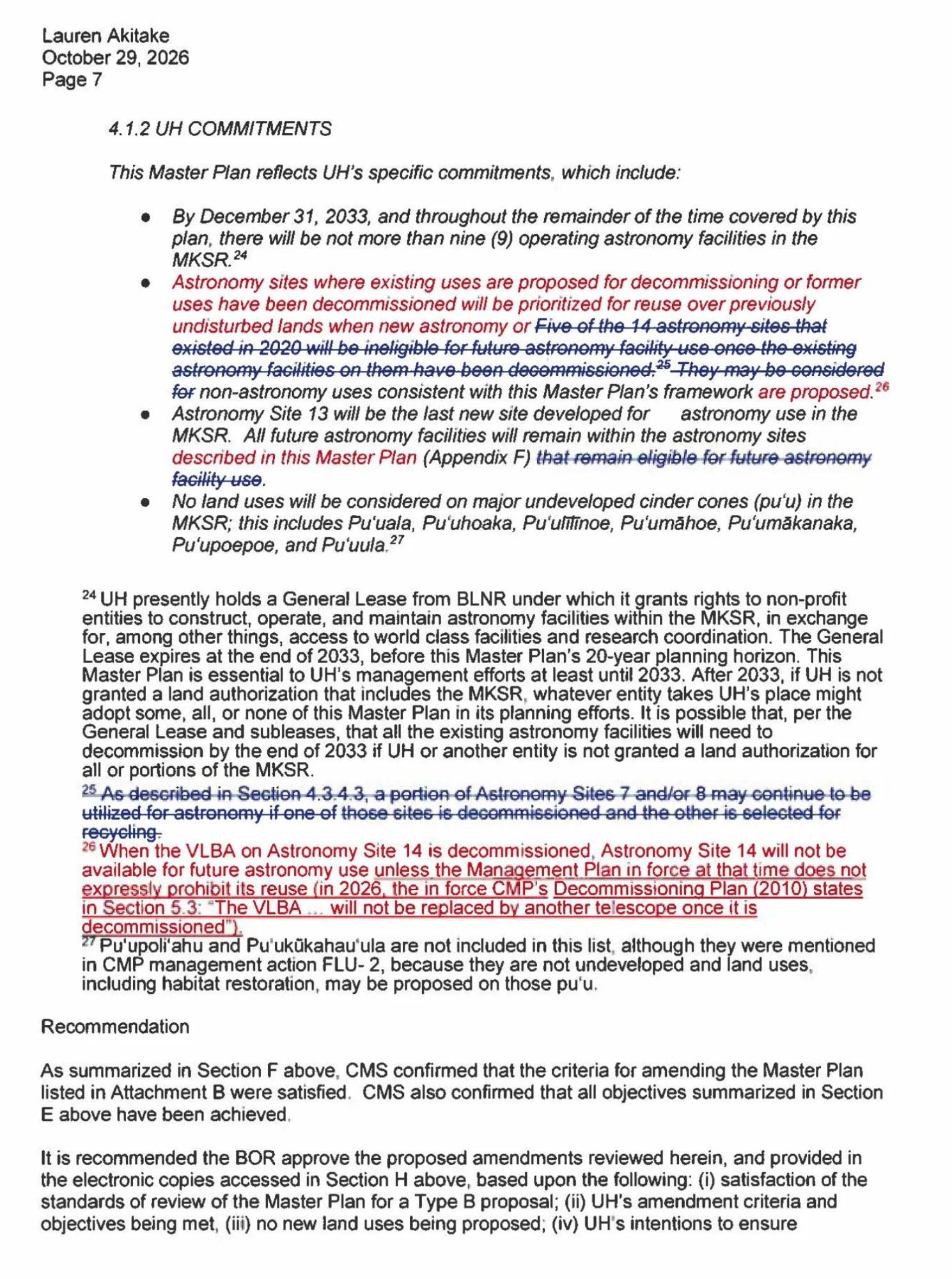
A Promise, Deleted
The 2022 Master Plan said: “Five of the 14 astronomy sites that existed in 2020 will be ineligible for future astronomy facility use once the existing astronomy facilities on them have been decommissioned.”
The amendment strikes that sentence (packet p.115). In its place, it says that decommissioned sites “will be prioritized for reuse over previously undisturbed lands when new astronomy or non-astronomy uses consistent with this Master Plan’s framework are proposed.” It also deletes language that limited new telescopes to sites “that remain eligible for future astronomy facility use.”
Three commitments stay in place:
- the cap of nine operating observatories by 2033,
- Site 13 as the last new site,
- the ban on development of the major undeveloped puʻu.
What the Paperwork Says, in Plain Language
- “Reuse” is UH’s word for new construction on a retired telescope site. One public commenter noted that it contains “no actual directive” to decommission sites or restore the ʻāina (p.134).
- “Type B proposal” is the review track UH used. UH marked 9 of 12 review criteria “not applicable” because “no activity or land use is proposed” (pp.130–131). The criteria set aside include benefit to the Hawaiʻi Island community, cultural needs, and consistency with Conservation District law.
- Site 14 (the VLBA radio telescope): a new footnote says the site “will not be available for future astronomy use unless the Management Plan in force at that time does not expressly prohibit its reuse.” It is written as a double negative, so it reads like a ban but works as a permission. Today, the 2010 Decommissioning Plan says the VLBA “will not be replaced by another telescope once it is decommissioned.” UH chose not to amend that plan.
- “Becomes moot”: Special Condition 10 of the Thirty Meter Telescope (TMT) permit, CDUP-3568, permanently removes three sites from consideration for new astronomy. UH lays out three scenarios. In the third, if TMT International Observatory wants a different site, the condition “becomes moot” and a new application would be required (p.112).
- A contradiction: UH’s memo lists “TMT CDUP conditions remain unchanged” as an objective (p.111). Its own review table says the revision conflicts with Special Condition 10 (p.112).
“May,” Not “Must”
UH says the change brings the plan into line with Act 255 (2022). That law created the Mauna Kea Stewardship and Oversight Authority (MKSOA), which will take over management of the mauna from UH. Act 255 says the Authority’s framework for astronomy development “may include” prioritizing the reuse of decommissioned sites. UH’s own side-by-side comparison shows that wording (p.110). The law gives that decision to the Authority, not to UH.
One commenter put it plainly: deleting the sentence is “an administrative choice, not a statutory requirement” (p.134). Another noted that UH “is not required by Act 255 to weaken the current Master Plan’s protections before the transition” (pp.133–134). The memo does not address either point directly.
The timing matters. Act 53 (2026) pushed the handover to the Authority back to December 1, 2029. It also keeps UH’s existing plans in force until the Authority adopts its own (p.110). Whatever the Regents approve Thursday is the rulebook the Authority inherits.
A UH slide also says the Authority can extend existing leases for up to 10 years with an exemption from Chapter 343 environmental review (p.119). UH’s current lease expires at the end of 2033.
The Consultation Record
- Online comments: UH’s comment period ran from September 9 to October 14 and drew 39 comments from 11 commenters (p.113). At least 21 of those came from four commenters whose notes read like internal edits, such as “Add comma here” and “we (UH)” (pp.143–152).
- MKSOA: the Authority’s board voted to neither approve, oppose, nor comment, and forwarded its testimony to the Regents. By UH’s count, on-time testimony ran 41 opposed and 36 in support. Support pulled ahead, 60 to 55, only after 38 late submissions were added (p.114).
- Kahu Kū Mauna: UH’s Native Hawaiian cultural advisory council for Maunakea was consulted once, on August 27. A second session, set for October 1, was canceled because of post-storm disruptions. The memo lists no rescheduled session (p.112).
- Missing pages: the packet reproduces only one of the five amended sections. The other four (4.3.2, 4.3.3, 7.2 and Appendix E) appear only as links.
- UH’s own reviewers: one wrote that UH has not “discussed this conundrum in much depth,” referring to the 2033 lease expiration (p.145). Another suggested explaining that UH limited the changes to the Master Plan “to avoid an even more complex process” (p.143).
Our Asks
- Pull Item VII.A.2 from the consent agenda so it is discussed on its own.
- Defer the vote until the Authority adopts its own plan.
- Define what “non-astronomy uses” means.
- Answer the public comments on the record.
How to Testify
The Board meets Thursday, November 19, at 9:30 a.m. at UH Mānoa, Bachman Hall, Room 106 A/B, 2444 Dole Street, Honolulu. The meeting will be livestreamed at hawaii.edu/bor.
- Written testimony: email bor.testimony@hawaii.edu or use the testimony link at hawaii.edu/bor. Reference “Agenda Item VII.A.2, Maunakea Master Plan Amendments.” Testimony is accepted until the meeting ends.
- Oral testimony: register online by 8:00 a.m. Thursday, or sign up in person at Bachman Hall 15 minutes before the meeting. Testimony is limited to three minutes.
Source: University of Hawaiʻi Board of Regents meeting materials for November 19, 2026, including the October 29, 2026 Board Action Memo from UH Hilo Chancellor Bonnie Irwin on behalf of the Center for Maunakea Stewardship. Page numbers refer to the packet’s page stamps.